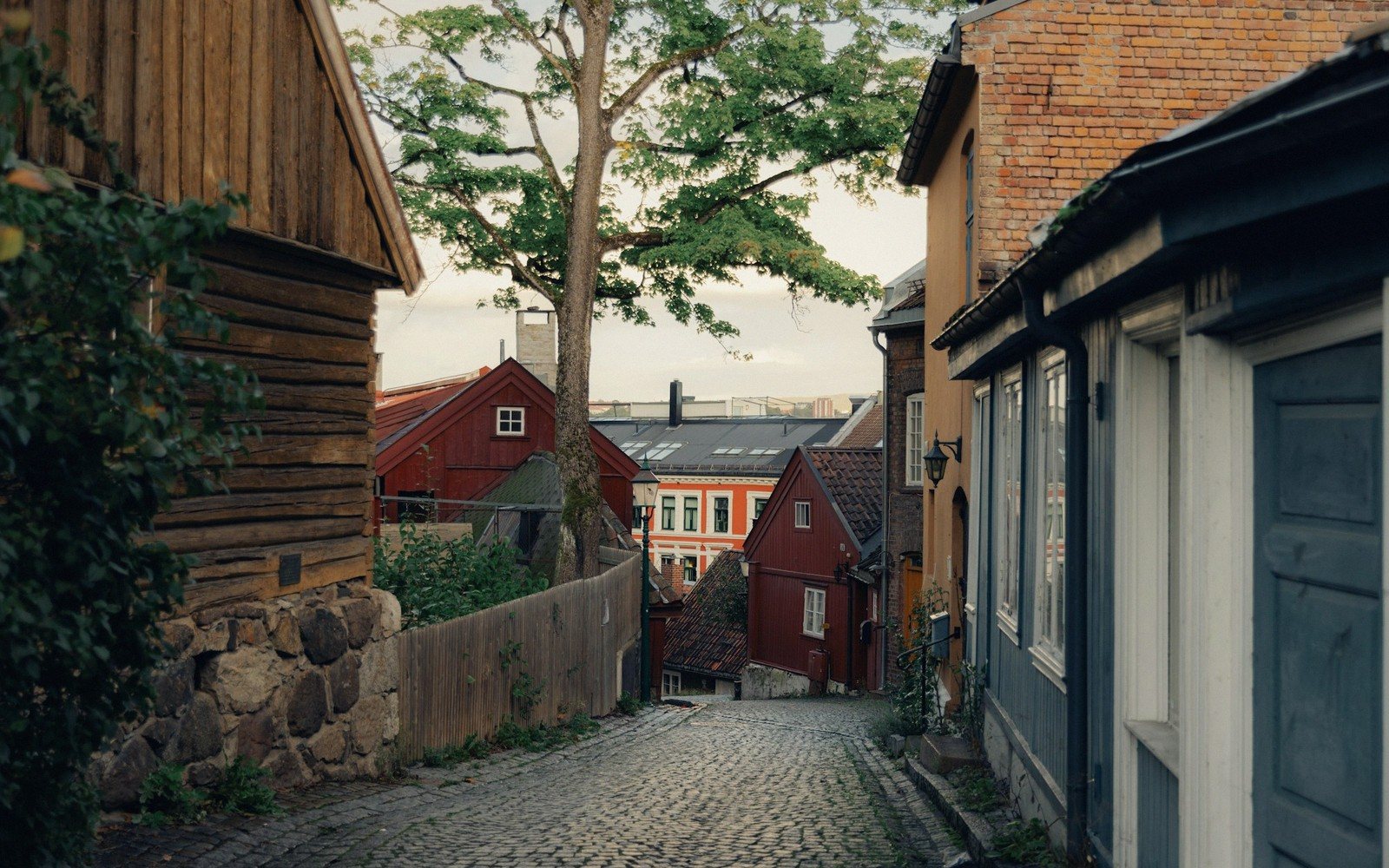
A medieval core, a long sandy shore and a monastery that still stands at the heart of the town.
01A town that holds its shape
Ystad sits at the southern edge of Scania roughly halfway along the coast between Malmö and Sandhammaren, where the agricultural plain meets the sea with almost no transition — no cliffs, no drama, just beach grass and then sand. The town is small enough to cross on foot in fifteen minutes, compact enough that its medieval street plan has survived largely intact.
The centre rewards slow walking. Stortorget, the main square, is framed by low buildings that lean slightly into each other in the way of old market towns, and the lanes radiating from it — Stora Östergatan especially — carry a density of half-timbered houses unusual even by Scanian standards. Some date to the sixteenth and seventeenth centuries. The timbers have gone dark with age and the upper storeys jut out over the narrow pavement in a way that makes the streets feel more enclosed than the latitude should allow.
St Petri Church stands just off the square: a large brick Gothic structure begun in the thirteenth century, its interior stripped back to bare whitewashed walls in the way of Lutheran conversion, which gives it a cool severity that suits the building. But the more arresting site is the Greyfriars monastery — Franciscan, founded in the mid-thirteenth century — which occupies a quiet block on the eastern edge of the old town. It is one of the best-preserved medieval monastic complexes in Scandinavia. The buildings are still in use, and now house the town's museum., and the cloister garden closes it all into something that feels genuinely self-contained, as if the surrounding town were the intrusion.
Ystad's beach lies ten minutes south of the centre on foot. It is wide and pale, backed by low dunes and the coastal road, and it stretches east and west without interruption. In early summer the water here is cold enough to be bracing; by late July it warms to something approaching comfortable. The beach is popular with visitors from further inland but rarely crowded by any coastal standard.
The town also functions as a ferry port — connections run to Bornholm and across to Poland — which gives it a mild transience that most Scanian towns lack. Travellers pass through. The old town absorbs this without much visible effort.
The ridge country of the interior begins only a short distance north. Söderåsen is the larger formation further west, but the low wooded ridges behind Ystad offer a quieter version of the same geology: beech on the slopes, open farmland on top, and views south across the plain to the grey line of the sea.
| Place | What it is |
|---|---|
| Ystad | medieval market town on Scania's south coast, roughly midway along the southern shore |
| Greyfriars monastery (Franciscan) | mid-13th-century monastic complex, among the best-preserved in Scandinavia |
| St Petri Church | large Gothic brick church, Ystad centre, 13th century origins |
| Stora Östergatan | principal historic lane in Ystad, notable for half-timbered houses |
| Stortorget | central market square, Ystad |