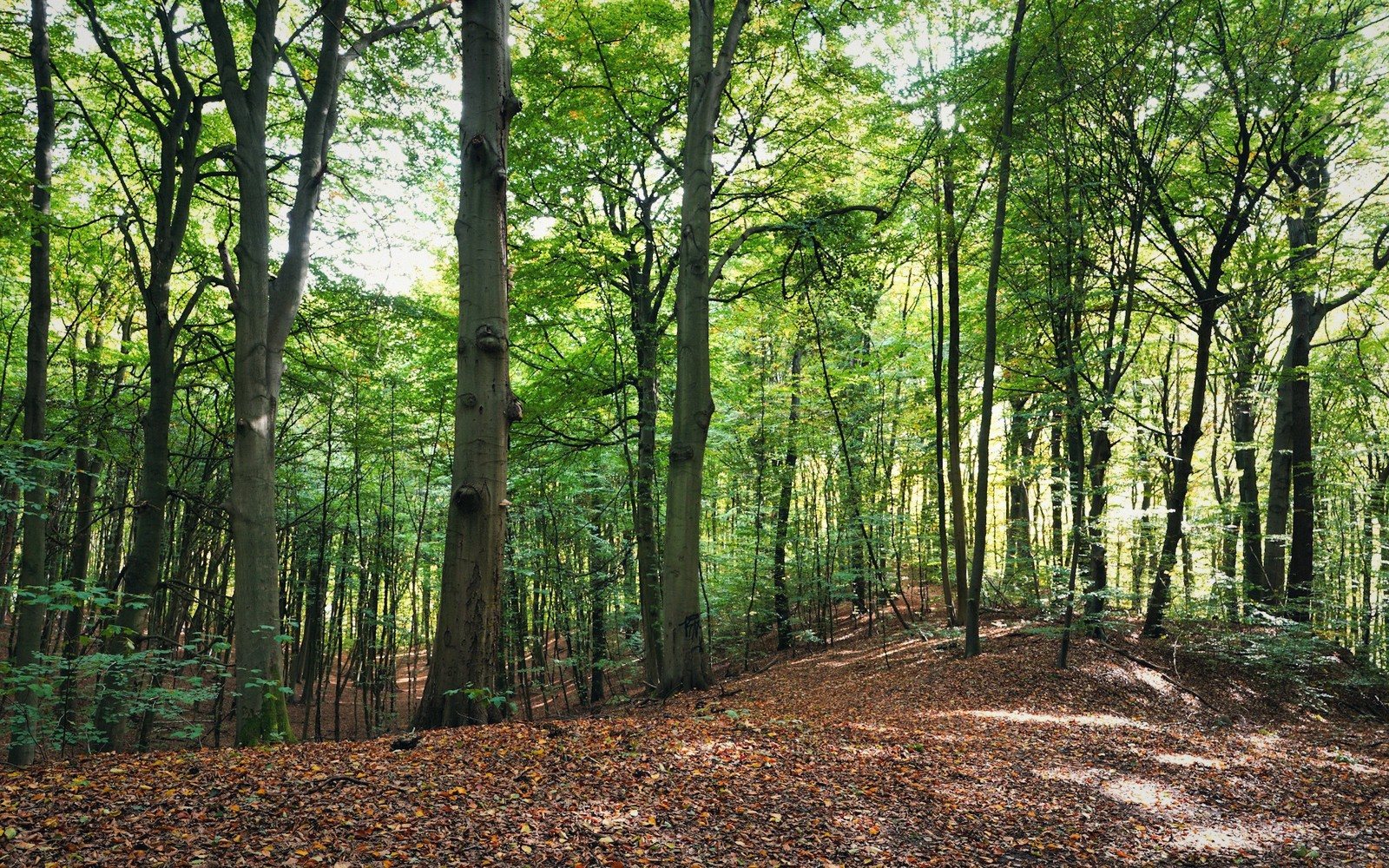
Fagus sylvatica dominates the Scanian interior. One species sets the light, the ground flora and the entire rhythm of the woods.
01Leaves up, leaves down
Beech arrived in Scandinavia relatively late in post-glacial terms, spreading north as the climate stabilised, and it spread well beyond Scania into Halland and southern Småland, reaching its northern limit in southern Sweden — Scania lies in the heart of its Swedish range. That accident of biogeography explains why the south of the country feels so different from the pine-and-spruce country further north. Walk into the interior ridge country of Söderåsen in May and you are inside a fully broadleaved forest, pale and echoing, that would not look out of place in Normandy or the Eifel.
The beech year begins in earnest in late April or early May. The opening of the leaves is called lövsprickning in Swedish, and it happens fast — a week of mild weather can take a tree from bare grey twigs to full, translucent canopy. The new leaves at that moment are lime-green and almost luminous, thin enough for light to pass through them, and the floor of the wood receives more light in this brief window than it will see again until autumn. This is not incidental. The entire ground-flora calendar of a beech wood is organised around it.
Anemones, wood sorrel and lesser celandine all complete most of their growth before the canopy closes. Ramsons — wild garlic — can carpet whole slopes through April, the smell arriving before the white flowers come into view. By June the canopy has shut and the floor is in deep shade: only a few shade-tolerant specialists, mosses and ferns among them, carry on below.
02The closed canopy and what it means
A mature beech in full summer leaf is one of the more effective light-interceptors in the European forest. The dense, overlapping leaves — smooth, oval, with a slightly wavy margin — can reduce incident light at ground level to a small fraction of what falls on the canopy. This is why a mid-summer beech interior feels hushed and dim and why the soil beneath stays relatively bare of low vegetation. It also means the litter layer accumulates slowly and breaks down slowly, producing an acidic, low-nutrient humus — moder — that further limits what can grow.
Fungi respond to this chemistry precisely. From late summer into October, the ground beneath beech produces a reliable sequence of species — milkcaps, brittlegills and various boletes among them — that are associated specifically with beech roots via mycorrhizal partnerships. The tree is in exchange with its fungi year-round, but the fruiting bodies that mark this relationship become visible as summer tips into autumn.
Insects, birds and small mammals all structure their year around beech too. The tree masts irregularly — producing very large crops of beechnuts, called bokollon, in cycles rather than every year — and in mast years the effect on wood mice, jays and bramblings can be dramatic. Jays cache the nuts and forget a fraction of them; those forgotten seeds are how beech regenerates across a forest floor cleared by wind or management.
This is why a mid-summer beech interior feels hushed and dim and why the soil beneath stays relatively bare of low vegetation.
03Autumn and the long dying
The colour change in a beech wood is not the mixed reds and oranges of a North American fall. It is a single, deepening progression through yellow into copper and then into a dry, warm brown — the same colour as strong tea. On a cloudy October afternoon, with the leaves still on, a beech interior glows faintly from within. After leaf-fall the dead leaves stay on the ground through winter, slow to rot, and some trees — particularly younger ones — hold their dead foliage on the branch until the new leaves push them off in spring. This is called marcescence and it is a feature of beech that catches visitors by surprise: a winter wood that appears, from a distance, to still be in autumn.
The bare grey trunks and their smooth, elephantine bark are in some ways the most distinctive thing about beech — winter reduces the wood to pure form. Then the light lifts, the first anemones show at the base of the roots and the whole cycle tips forward again into another lövsprickning, another brief window when the floor of the wood briefly belongs to the sun.
| Place | What it is |
|---|---|
| Söderåsen | rift-valley ridge in north-west Scania; stronghold of mature beech forest |
| Fagus sylvatica | European beech; the species discussed throughout |