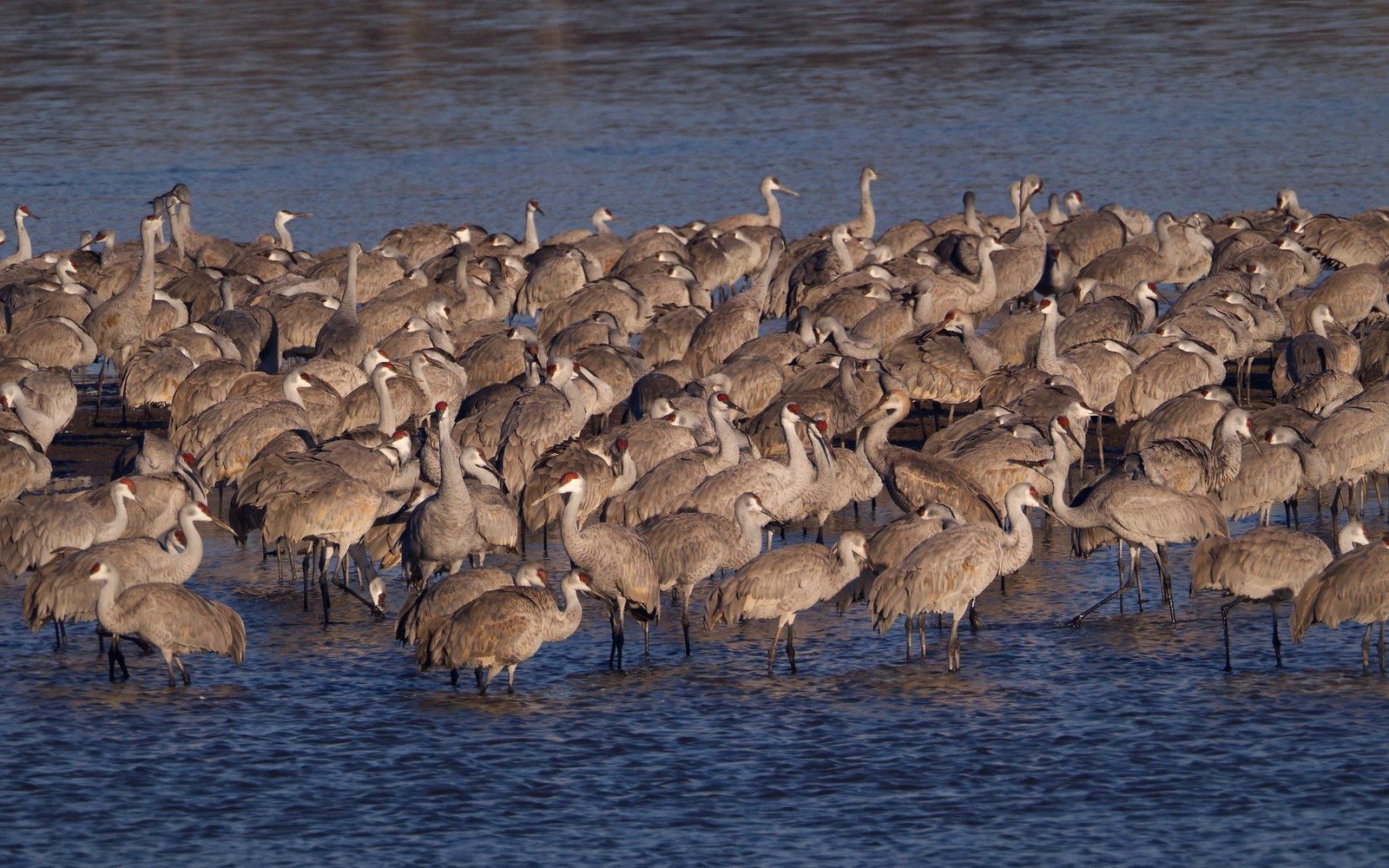
The mudflat holds more information than it first appears to. Learning to read it is half the pleasure.
01What the Shore Actually Offers
Scania's coastline runs from hard cliff to open sand to sheltered estuary, and the variety matters — not for scenery, but because each substrate holds different food. A rocky shelf at Kullaberg holds almost no invertebrate mud-life; a shallow flooded wetland at Kristianstads Vattenrike holds an enormous amount. Waders, as a group, have evolved to exploit exactly these gradients. The length of a bill, the angle at which it probes, the depth a bird wades — all of it maps onto a particular food source at a particular depth. A dunlin and a black-tailed godwit can work the same fifty metres of shore without competing.
The key sites cluster where fresh water meets salt, or where sheltered bays slow the wave energy enough for silt to accumulate. Falsterbo and its surrounding lagoons, the marshes around Hanöbukten, the slow channels of Kristianstads Vattenrike — these are not interchangeable. Each has its season, its specialist species, its particular quality of light and exposure.
02The Running Calendar
Spring passage begins earlier than most visitors expect. Lapwing and golden plover move through the agricultural fields in late winter, before the coast itself warms. By early April, dunlin are streaming north in numbers, accompanied by ringed plover, which will stay to breed on sandy stretches near Sandhammaren and along the Falsterbo peninsula. Little stint and curlew sandpiper — long-distance migrants from Siberia — pass through in May and again, in much larger numbers, in August.
Terns arrive when the water temperature is sufficient to concentrate sand eels near the surface. Common and Arctic terns appear over the Öresund from late April; Sandwich terns favour more exposed coastal waters and are regular off Falsterbo. Little terns are the ones to watch for on the open beach, hovering low over the shallows before diving almost vertically. They breed in small, vulnerable colonies on flat sand, making them easy to miss and easy to disturb.
High summer is quieter for waders — the birds are on their Arctic breeding grounds — but by July the return migration has already begun. Juvenile birds appear on the shore by late July, confusingly different in plumage from the adults that preceded them by weeks. A grey-brown bird picking along the tideline in August may be any of several species; this is when a field guide earns its keep. The period from late July through September is the richest window on any Scanian estuary.
Autumn concentrates what spring dispersed. Curlews gather on the mudflats in numbers, their calls carrying a long way in flat, cold air. Knot and bar-tailed godwit move through, often in mixed flocks. Ruff gather at favoured wetlands. Grey plover, in transition from summer black to winter grey, work the water's edge with a deliberate, slightly melancholy quality. By October the wader season is thinning, but the terns are still moving — and to stand at Falsterbo in mid-September, with thousands of terns pushing south-west past the point, is one of the better things the Scanian shore produces.
Juvenile birds appear on the shore by late July, confusingly different in plumage from the adults that preceded them by weeks.
03How to Stand Still
The basic technique is patience and positioning: arrive before the birds, settle downwind, and let the shore come to you. Mudflats are best worked when water levels are low and the feeding zone is exposed and the birds are close. Binoculars matter more than a telescope for general reading of the flat; a scope earns its weight when identifying distant godwits or separating similar-sized stints. Allemansrätten gives legal access to almost all of this shoreline — the only obligation is not to disturb breeding birds on the sand.
| Place | What it is |
|---|---|
| Kristianstads Vattenrike | UNESCO biosphere reserve; slow river and wetland complex near Kristianstad |
| Falsterbo | peninsula and point at Sweden's south-western tip; major migration watchpoint |
| Sandhammaren | long sand spit at Sweden's south-eastern corner; ringed plover breeding habitat |
| Hanöbukten | large open bay on the south-east coast of Scania |