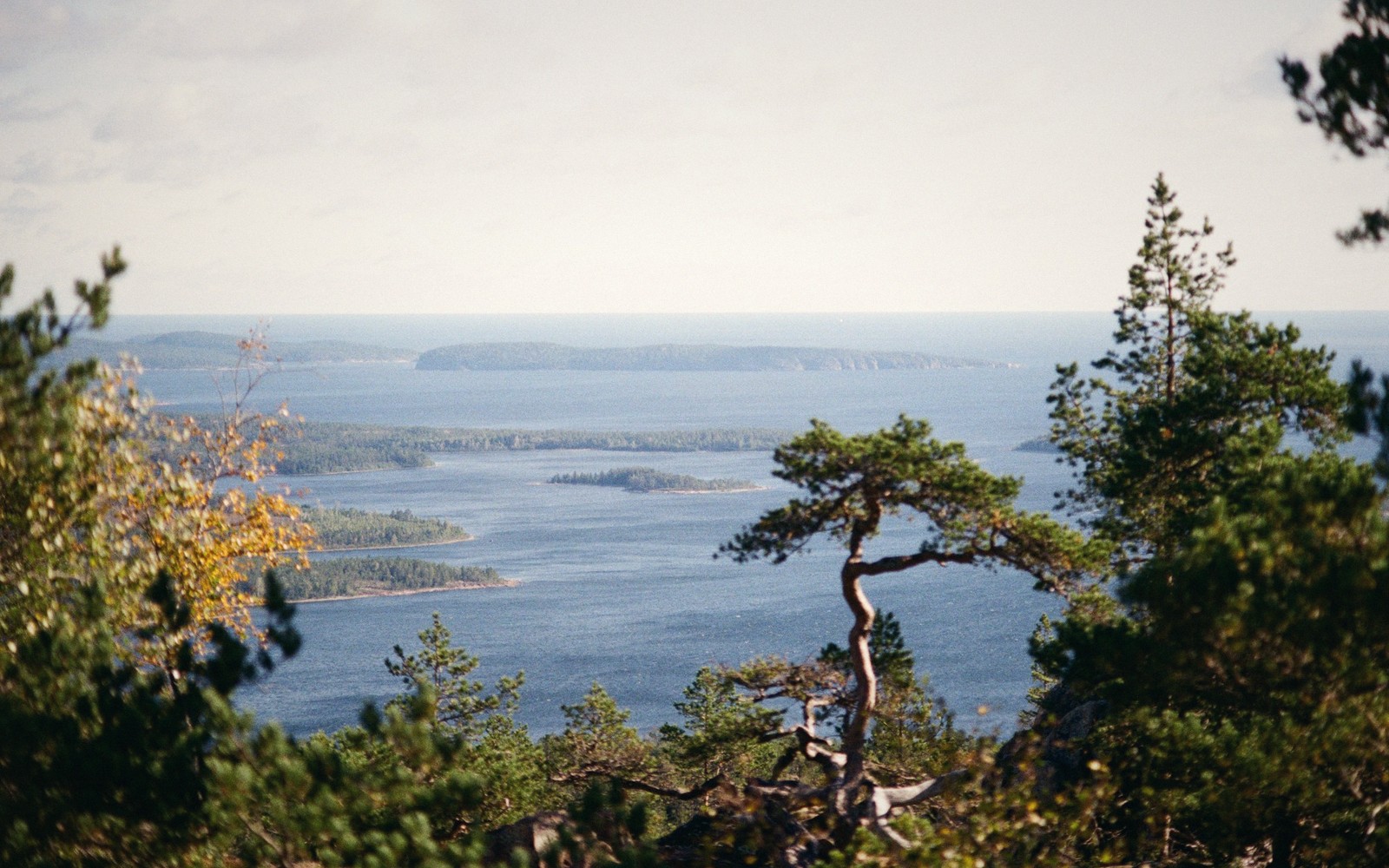
A granite headland on the east coast where the rock runs straight into the Baltic and the warmth-loving plants have no business being this far north.
01A Head of Rock on a Flat Shore
The Scanian coast is, for the most part, a low thing — sand bars and dunes, shallow bays and beach meadows lying barely above the tideline. Stenshuvud breaks all of that. The headland rises to just over a hundred metres, a Precambrian granite boss that the last ice sheet scraped and smoothed but could not reduce to the surrounding plain. From its summit you look south across Hanöbukten towards Kristianstad and west into the interior, a genuinely elevated prospect in a province that rarely offers one.
The national park — established in 1986 — covers roughly four square kilometres of headland and flanking coast, taking in rocky shore, sandy beach, deciduous forest, heath and even a patch of sand steppe. That compression of habitats in a small area is part of why Stenshuvud matters. The other part is the rock itself.
02Why the Flora Surprises You
Granite holds and radiates heat. The south-facing slopes of Stenshuvud warm earlier in spring and stay warm longer into autumn than the surrounding lowland, creating a local climate that suits species more typical of central European or even Mediterranean latitudes. Ivy climbs the rock faces in dense curtains. Spurge laurel, a plant at or very near its Scandinavian northern limit here, flowers in late winter when the rest of the landscape is still grey. Small-leaved lime grows naturally on the slopes — genuinely wild, not planted — and hazel fills the understorey so thickly that the hazelnuts bring dormice at night.
The forest here is not the broad-canopied beech woodland that dominates Söderåsen and the inland ridges. It is a mixed, broken thing, with oak and ash and hornbeam threading through the lime and hazel, mosses deep over the boulders and, in clearings, a dry-heath flora of heather and sheep's fescue. The transitions are abrupt: a few metres of descent from dry rock to sheltered gully and the air turns cool and damp, the ground flora changes almost immediately.
The heath on the upper slopes and southern flank holds adders, drawn to the same warmth that attracts the thermophilic plants.
03Shore, Heath and the Animals That Use Them
The sandy beach at the headland's southern foot gives way northward to boulder shore and sea stacks — the only sea stacks of any size on the Scanian east coast. Harbour seals rest on the lower rocks, particularly in late summer and autumn; they have used this stretch of coast for decades. In the shallow water just offshore, common eiders are a reliable winter presence, and the headland itself is good ground for raptors in migration, its bulk acting as a minor concentration point when the winds bring broad-front movement down from the north.
The heath on the upper slopes and southern flank holds adders, drawn to the same warmth that attracts the thermophilic plants. Sand lizards are common on the open ground. The dormice — hazel dormice, Sweden's only native dormouse species — are rarely seen but audible on summer nights, and the hazel crop in good mast years is enough to support a healthy population through into hibernation.
04Visiting
The park lies between Kivik and Skillinge, accessed from the small coastal road. A network of unmarked but well-walked paths leads from the visitor centre to the summit, the shore and the heath; the terrain is modest enough that most visitors can reach the highest ground without difficulty. Allemansrätten applies, but as a national park the area carries its own guidance on where to walk and where to hold back, particularly near the seal resting sites in late summer.
The best months to be here are probably May — when the thermophilic shrubs are in flower and the migrant birds have just arrived — and September, when the seals are most reliably on the rocks and the forest is beginning to turn.
| Place | What it is |
|---|---|
| Stenshuvud | granite headland and national park on Scania's east coast, between Kivik and Skillinge |
| Hanöbukten | large bay forming the eastern coastline of Scania |
| Söderåsen | inland ridge national park dominated by beech forest |