A cathedral, a university and a compact centre you can cross on foot in an afternoon — if you don't stop too long in front of the crypt.
01Stone First
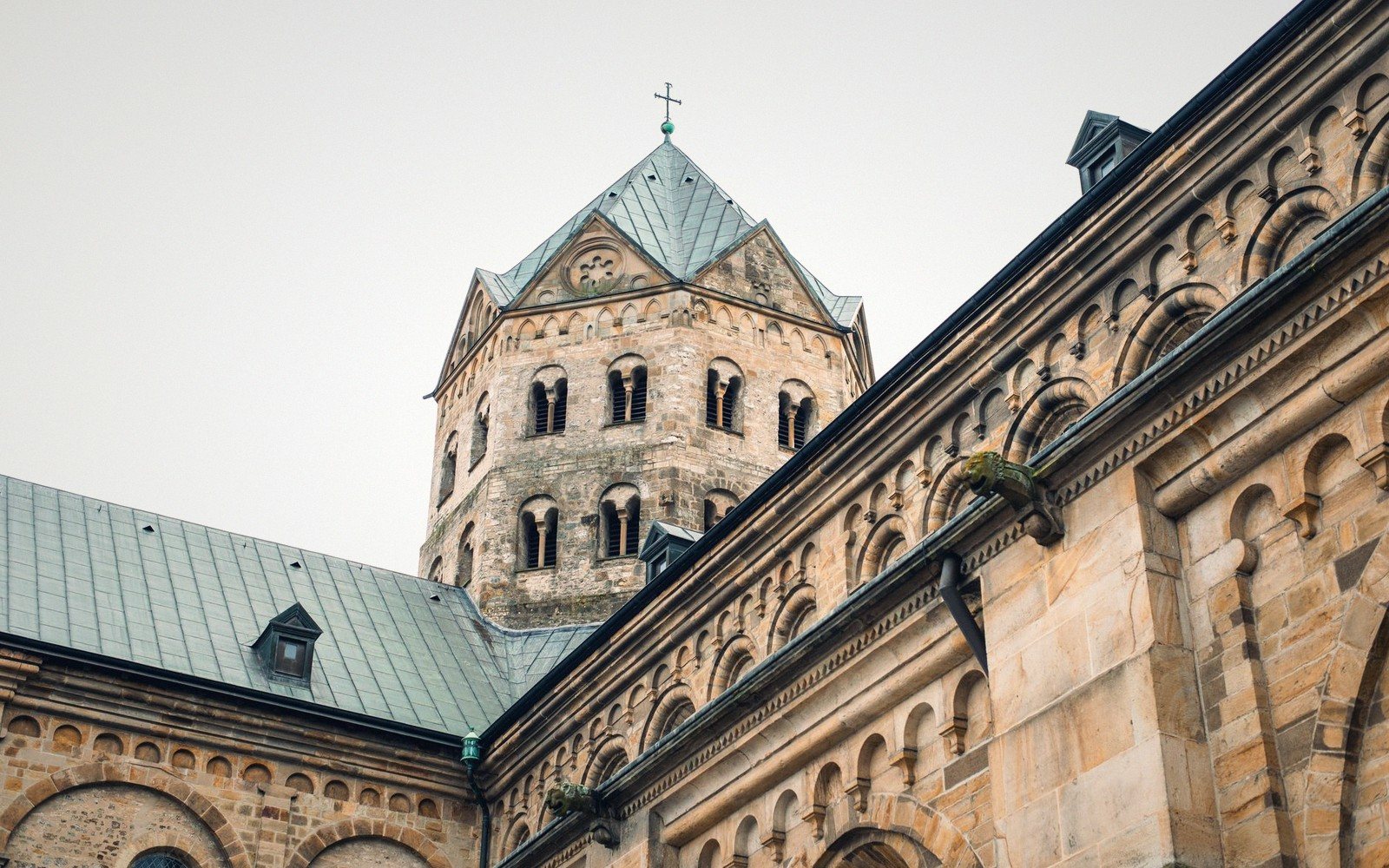
Lund's cathedral announces itself before you have found the main square. The twin towers of Domkyrkan rise above every roofline in the centre, and the whole city orients itself around them. Building began in the early twelfth century and the church was consecrated in 1145, making it one of the oldest Romanesque buildings in Scandinavia still standing largely intact. The stone is a pale grey sandstone quarried locally, and the exterior weathers to something between silver and bone depending on the light and the season.
The west façade is severe — almost nothing decorative, just the weight of cut stone laid in courses — but walk around to the crypt entrance and the scale shifts. The crypt dates from the earliest phase of construction and is supported by columns carved with figures that have the compressed, muscular quality of Romanesque stonework everywhere: giants gripping the shafts, foliage dissolving into faces. The two statues nearest the central pillars are known as Finn and his wife, tied to a local legend about the giant said to have helped build the cathedral. The story is probably medieval invention, but the figures are real and worth standing in front of longer than most visitors do.
Inside the main nave, the astronomical clock — the Horologium mirabile Lundense — occupies a niche in the north wall. It dates from around 1425, though the mechanism was restored in the twentieth century. Twice a day it runs through a short automated sequence; the timing is posted at the entrance. Whether you catch it or not, the clock face itself, with its concentric rings showing Julian calendar, the position of the sun and moon, and the phases of the lunar cycle, rewards close attention.
02The University Underneath
Lund University was founded in 1666, shortly after Scania was ceded from Denmark to Sweden by the Treaty of Roskilde, and the founding of a Swedish university here was an explicit act of cultural consolidation — a statement that this was now Sweden's south, not Denmark's north. The university has never left. It now enrols tens of thousands of students and shapes the entire feel of the city: the café culture, the bicycle density, the bookshops still somehow surviving. During term the centre is alive with a particular kind of purposeful movement; in summer it quietens to something almost sleepy.
The main university building — Universitetsplatsen, facing the park — dates from the 1880s and sits beside the university library, Universitetsbiblioteket. The botanical garden, Botaniska trädgården, is a short walk away and worth an hour on its own terms: the outdoor sections are free and open year-round under allemansrätten's gentler urban cousin, and the greenhouses extend the range considerably. The garden holds a substantial collection of plants from across the world's climate zones, maintained for both teaching and research.
During term the centre is alive with a particular kind of purposeful movement; in summer it quietens to something almost sleepy.
03The Compact Middle
Lund's centre is small enough that getting lost is more or less impossible, which makes it a good city for the kind of walking that has no fixed objective. The medieval street pattern survives in places, particularly around Mårtenstorget and the lanes leading south from the cathedral. The half-timbering that characterises towns further east in Scania appears here too, though mixed with later academic building in a way that feels accumulated rather than designed.
Kulturen — formally Kulturhistoriska föreningen för södra Sverige — is an open-air museum of historic buildings reassembled on a plot just south of the cathedral. Founded in 1882, it is among the older open-air museums in the world and contains relocated structures spanning several centuries, from urban merchants' houses to rural cottages. Its scale is domestic rather than monumental, which suits it.
The distances are short. Cathedral to Kulturen: a few minutes on foot. Kulturen to the botanical garden: ten minutes at a moderate pace. There is nothing in the centre that requires a vehicle or much planning. The city rewards the unhurried approach — the kind of afternoon where you sit outside a café longer than intended because the light on the old stone is doing something worth watching, and you have no particular reason to be elsewhere.
| Place | What it is |
|---|---|
| Domkyrkan | Lund Cathedral; Romanesque, twin-towered, consecrated 1145 |
| Horologium mirabile Lundense | medieval astronomical clock in the cathedral's north wall |
| Kulturen (Kulturhistoriska föreningen för södra Sverige) | open-air historic buildings museum south of the cathedral, founded 1882 |
| Botaniska trädgården | Lund University's botanical garden; outdoor beds and greenhouses |
| Universitetsbiblioteket | Lund University library, beside the main university building |
| Finn and his wife | carved Romanesque figures in the cathedral crypt, linked to a medieval building legend |