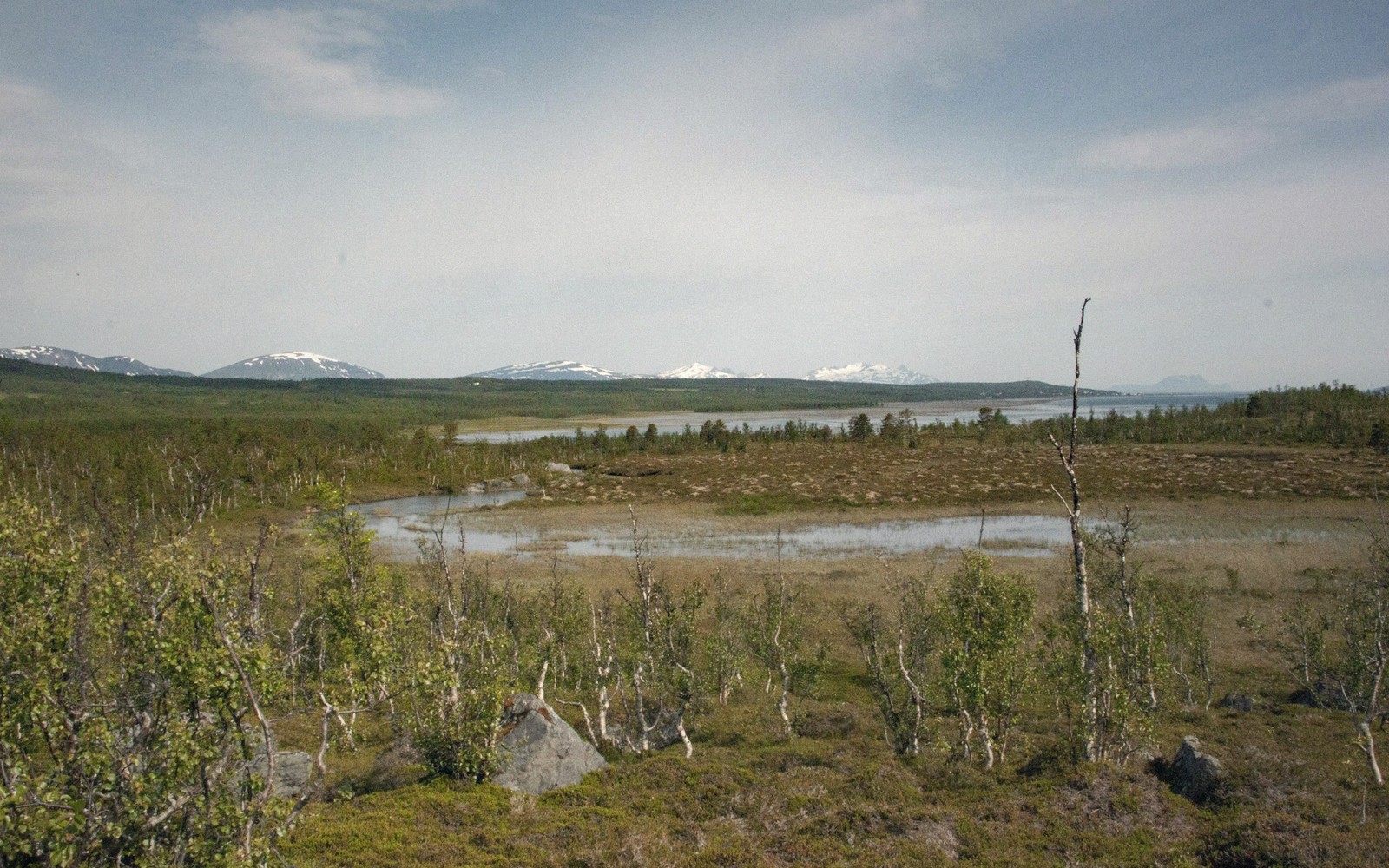
A shallow floodplain where the Helge å meets the Baltic — and one of the most bird-rich lowlands in northern Europe.
01The Water Kingdom
The name is almost literal: vattenrike means water kingdom, and the biosphere reserve that carries it is, above all, a wet place. The Helge å — the largest river in Scania — empties into the Baltic at Hanöbukten through a broad, flat delta of fens, wet meadows, willow carr and shallow lakes. The town of Kristianstad sits at the edge of all this, built on what was once a fortified island but now borders a mosaic of habitats so compressed and varied that the Swedish UNESCO biosphere designation, awarded in 2005, understates how strange and productive the landscape actually is.
The underlying reason is geology. The Helge å has, over millennia, deposited vast quantities of sediment across a basin that lies fractionally above sea level. Historically much of it flooded each spring; that flooding, managed by farmers for centuries, created the species-rich hay meadows that are now the reserve's most valuable ground. When the mowing stopped across large parts of Sweden's lowlands after mechanised farming arrived, these meadows vanished almost everywhere. At Vattenrike, coordinated grazing and late-summer mowing by the reserve's management has kept them open — which is why, in June, you can stand on flat ground and count a dozen wading bird species without moving your feet.
02Reading the Habitats
The reserve covers about eleven hundred square kilometres, but its richest ground clusters in two zones: the delta lakes and reedbeds to the east of Kristianstad, and the dry sandy steppe at Norra Sandby and Rinkaby to the north. These are not adjacent habitats sharing a fence — they are ecologically different worlds within easy cycling distance of each other, and that contrast is what makes the whole more than the sum of its parts.
The reedbeds hold marsh harriers in numbers unusual for this latitude, along with bittern, bearded reedling and great reed warbler — all species whose Swedish populations are small enough that Vattenrike carries disproportionate national weight. In spring the harriers display over the reed tops in the first warm mornings of April, the males performing slow undulating flights that are visible from the road without any optical equipment. Bittern is a sound before it is a bird: the low booming call carries across open fen on still evenings and is one of the distinctive sounds of the place.
Crane is ever-present from March onward. The shallow lakes and adjacent meadows provide exactly the roost and foraging conditions the species needs, and thousands gather in autumn. White-tailed eagle — once almost gone from southern Sweden, now fully re-established — hunts the open water through the year and breeds within the reserve.
The sandy steppe at Rinkaby is a different proposition: dry, open and warm, it supports plants and insects more typical of central Europe than coastal Sweden. Nightjar churrs from early June, stone curlew has bred here, and the sandy tracks hold a different suite of beetles and solitary wasps than anything in the wet ground to the south. The contrast requires some mental adjustment — standing among lichened sand with Scots pine overhead while knowing the reedbeds are fifteen minutes away by bicycle asks you to hold two landscapes in your head at once.
Waterfowl are most visible in early morning; harrier and eagle tend to appear mid-morning once thermals begin to form.
03Going There
Kristianstad is well connected by train, and the reserve's main information centre — run by the municipality — sits close to the town centre. The flat terrain and extensive network of minor roads and dyke-top paths makes the reserve unusually accessible; much of the best ground can be reached without specialist equipment or off-road walking. Allemansrätten applies, meaning the wet meadows and dyke edges are open to unhurried exploration on foot, though the management recommends staying on marked paths through the most sensitive nesting areas between April and June.
The reedbeds are best read from the raised hides and platforms near the lake of Araslövssjön; the sandy steppe needs only patience and low expectations of comfort — there is little shade, and the sun hits hard on a June afternoon. Waterfowl are most visible in early morning; harrier and eagle tend to appear mid-morning once thermals begin to form.
Winter has its own logic here. The unfrozen water holds diving ducks and smew; the meadows attract flocks of whooper swan and bean goose; the occasional rough-legged buzzard drifts in from the north. The reserve is not a place that closes in the cold months — it simply changes cast.
Vattenrike does not announce itself. The approach through flat agricultural Skåne gives no indication that the road is about to reach something of European significance. The water kingdom earns its name quietly, in the way a bittern earns its place in a reedbed: it is there if you slow down and learn where to look.
| Place | What it is |
|---|---|
| Kristianstad | town in north-east Scania; the reserve's gateway and administrative centre |
| Helge å | longest river in Scania; drains into Hanöbukten |
| Araslövssjön | lake within the reserve with hides overlooking open water and reedbed |
| Rinkaby | sandy steppe area within the reserve, north of Kristianstad |
| Hanöbukten | the Baltic bay into which the Helge å delta opens |