Short days, a sun that barely clears the trees, and why the season most visitors skip repays the ones who stay.
01A different kind of seeing
By December, the sun rises late over Scania and arcs so low through the south that it never fully lets go of the horizon. In a flat province, this matters more than it would in hill country. There is nothing to interrupt the light — no ridge to the south, no forest wall — so when the angle drops to ten or fifteen degrees at midday, it stays there for hours, raking across the landscape at a pitch that summer never reaches.
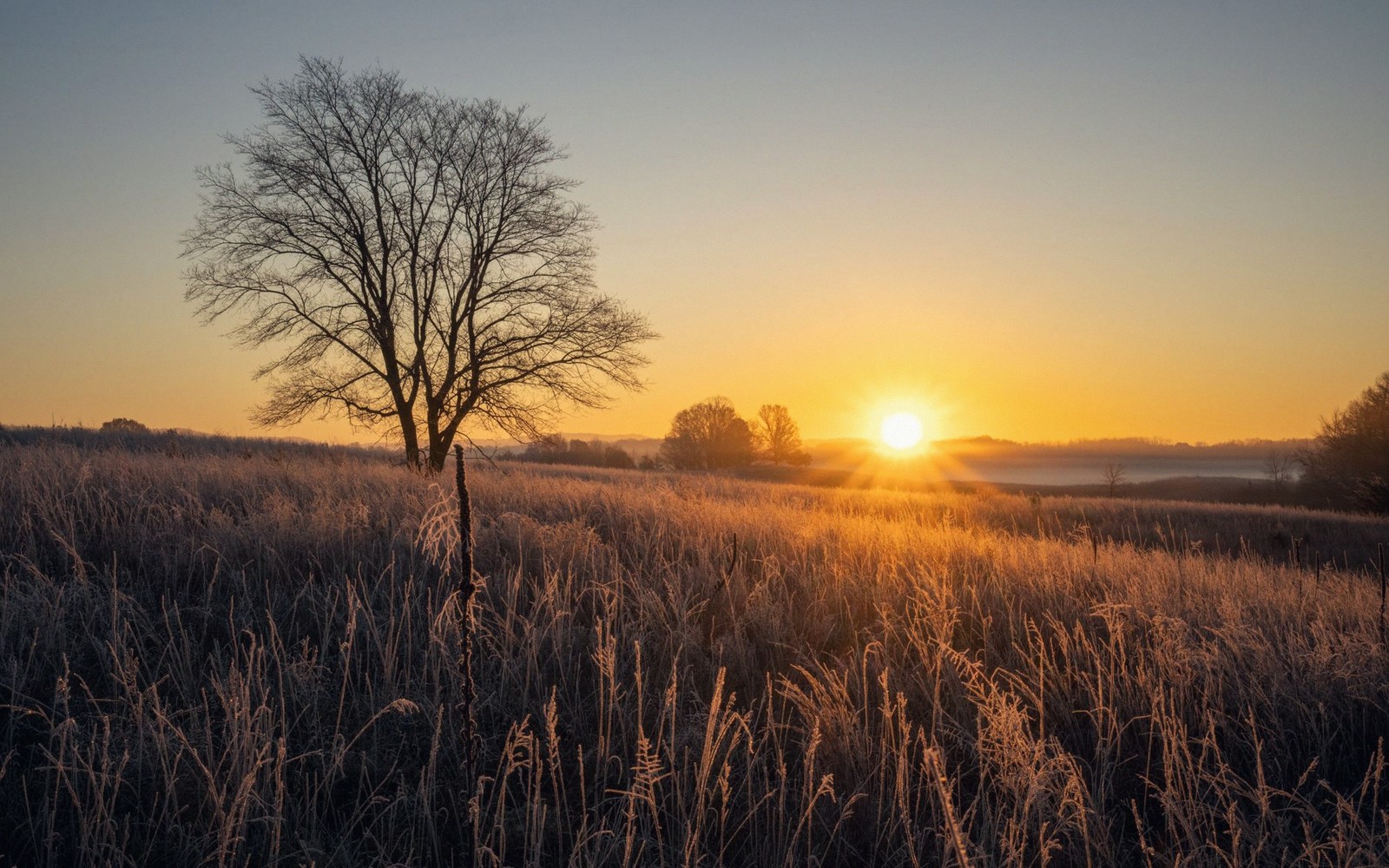
The effect on the open farmland is stark. Fields stripped to tilth or left in stubble catch light that comes in almost sideways, throwing furrow shadows ten times longer than the ridges that made them. A flooded ditch becomes a mirror. A line of willows on the horizon glows amber from one side and drops to silhouette from the other. There is nothing to look at, and everything to see.
On the coast the clarity can be startling. Onshore winds push the air inland, leaving the sea flat and pale, and the low sun turns the water to hammered pewter or, on calm mornings, something close to silver. At Falsterbo, where the peninsula hooks south-west into the Öresund, winter brings flocks of common eider and long-tailed duck riding offshore swells — compensation, of a kind, for the raptors that have gone. Along Hanöbukten, the broad east-facing bay south of Kristianstad, light reaches the sand cliffs at an angle that makes the coloured strata readable at a distance; the geological record laid out in winter sun.
Frost, when it comes, transforms the inland entirely. The beech-wood floors of Söderåsen and the wetland margins of Kristianstads Vattenrike lose their drab autumn grey and turn briefly to white lacework — spider threads and leaf edges and the last standing seedheads all outlined in ice crystals that catch the low light and hold it for an hour or two before the slight warmth of mid-morning takes them. After that, fog sometimes fills the valleys while the ridgetops stay clear, and the whole province rearranges itself into layered bands of murk and brightness.
The season rewards patience and early rising. The golden hour here is not an hour — on a clear winter morning, the golden light can persist from sunrise until ten o'clock, shift to something cooler but still oblique through the middle of the day, and then return to amber for the final run to dusk. For a region this flat, that is a remarkable amount of drama, spread unhurriedly across the shortest days of the year.
| Place | What it is |
|---|---|
| Falsterbo | low sandy peninsula at Scania's south-western tip, facing the Öresund |
| Hanöbukten | broad east-facing bay on Scania's south-east coast |
| Söderåsen | beech-forested rift-valley ridge in central-northern Scania |
| Kristianstads Vattenrike | wetland biosphere reserve around the lower Helge å river |
| Öresund | strait between Sweden and Denmark, flanking Scania's west coast |